
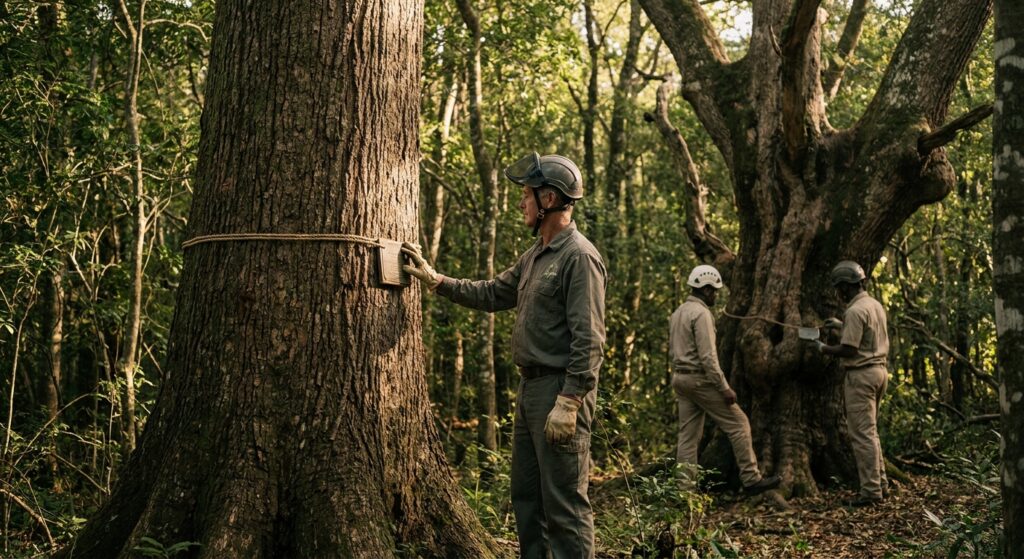
South African law protects specific indigenous tree species under the National Forests Act of 1998. You cannot cut; damage; or prune these trees without a permit issued by the Department of Forestry, Fisheries and the Environment. Common protected species include the Real Yellowwood, Camel Thorn, and Marula. Violating these regulations results in heavy fines or imprisonment regardless of whether the tree is on private or public land.
Regulatory Framework Of The National Forests Act
Illegal felling carries criminal weight. The National Forests Act prohibits the removal of any listed species to ensure biodiversity conservation; this legal barrier prevents the extinction of slow growing indigenous flora. Government officials enforce these protections through strict permit systems.
Technical compliance triggers for tree management include:
- Identification of species listed in the annual government gazette
- Submission of a formal licence application to the provincial forestry office
- Assessment of the ecological impact and necessity of the removal
- Adherence to specific pruning limitations defined by arborist standards
Securing legal approval is the first step in any technical felling operation within South African borders.
Technical Deep Dive Into Protected Species Identification
Accurate identification prevents legal exposure. Arborists must distinguish between common garden trees and protected indigenous variants like the Podocarpus latifolius. Correct species verification is the only way to avoid heavy fines and project delays.
Anatomy Of The Real Yellowwood
The Real Yellowwood features long; narrow leaves and a distinctive greyish bark that peels in strips. It is frequently confused with the Outeniqua Yellowwood; however; both species fall under the same protective status. Technical verification focuses on leaf vein patterns and fruit structure to confirm the legal requirements before any equipment arrives on site.
Permit Acquisition And Compliance Management
The permit process remains a significant bottleneck for property developers. The Department of Forestry, Fisheries and the Environment requires a detailed motivation for the removal of any protected specimen. This includes verifying that the tree poses a structural threat or that no alternative construction path exists.
Essential documentation for a successful permit application includes:
- Precise geographic coordinates of the specimen in question
- High resolution photographic evidence of the tree and its surroundings
- A professional arborist report detailing the health and safety risks
Precision Solutions With Power Tree Fellers
Power Tree Fellers operates with a strict compliance first methodology to manage indigenous flora. Our team identifies protected species during the initial site assessment to prevent legal complications for our clients. We manage the technical documentation required for forestry permits while ensuring minimal site disruption during the execution phase. Request a quote for a professional assessment by clicking the button below.
FAQs
Can I trim a protected tree if it is overhanging my roof?
No; you cannot trim; prune; or disturb any part of a protected tree without a permit from the Department of Forestry, Fisheries and the Environment. Even minor maintenance requires legal clearance to ensure the health of the specimen is not compromised.
Which trees are most commonly protected in urban gardens?
The Real Yellowwood and the Outeniqua Yellowwood are the most frequent protected species found in residential areas. In drier regions; the Camel Thorn and Shepherd’s Tree are the primary species requiring legal protection.
What are the penalties for cutting down a protected tree?
Offenders face significant financial penalties or up to three years of imprisonment for the unauthorised removal or damage of protected trees. These penalties apply to both the property owner and the contractor performing the work.
Does the law apply to dead protected trees?
Yes; the National Forests Act protects the tree regardless of its condition. You must still apply for a permit to remove a dead or dying protected tree to satisfy legal requirements and avoid potential prosecution.