
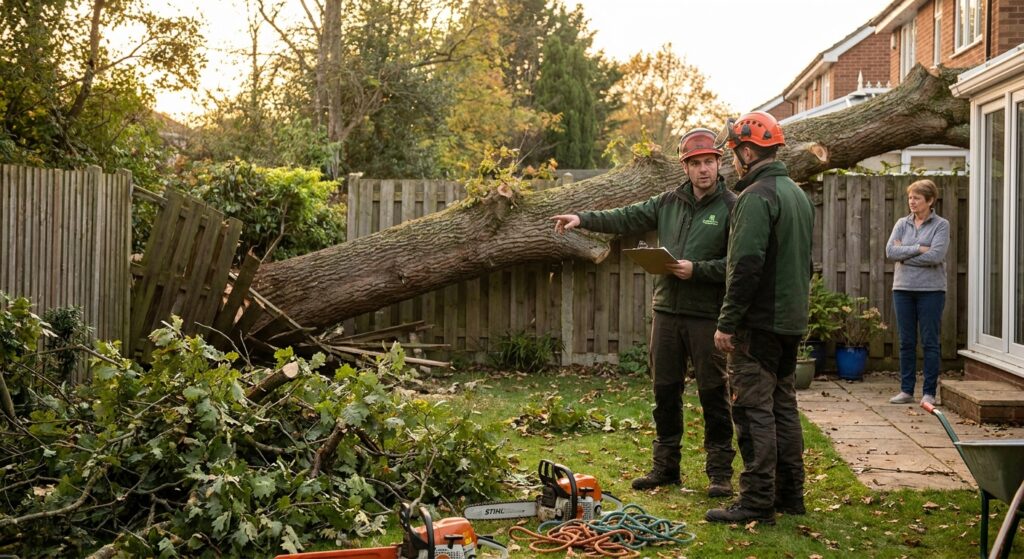
Responsibility for a fallen tree rests with the property owner or the contracted tree felling company. If a tree falls from your land onto a neighbouring property naturally, you are liable for the damages. When Power Tree Fellers is actively working on the tree, the responsibility shifts to the company insurance policy. The neighbour who receives the falling debris is not responsible for any associated costs.
Liability And Ownership Structures
Liability is determined by the point of origin and the presence of active professional intervention. South African property law requires owners to manage biological risks to prevent damage to adjacent structures. Legal accountability shifts only when a specialist service provider takes control of the tree physical state.
Core factors determining legal accountability include:
- Compliance with municipal by-laws regarding protected tree species
- Primary ownership of the land where the trunk is situated
- Active negligence regarding visible rot or structural instability
Identifying the root cause of the failure determines which insurance policy must be triggered.
Contractor Liability Framework
Professional contractors operate under a strict liability framework during the removal process. If a branch or trunk impacts a neighbour wall while Power Tree Fellers is on-site, the contractor must facilitate the repair process via their commercial insurance policy. This protection ensures that the property owner is not held liable for operational errors or equipment failures during the project.
Professional Risk Mitigation
Detailed site assessments prevent uncontrolled falls by identifying tension points and decay levels before any cuts are made. This technical preparation ensures that the tree weight is managed through rigging systems rather than gravity alone.
Operational safeguards implemented during active felling include:
- Deployment of heavy-duty rigging ropes to control descent speed
- Installation of ground protection mats to preserve neighbouring turf
- Establishment of clear felling hinges to dictate fall direction
Insurance Claim Evaluation
The insurance claim process requires specific technical evidence to validate a claim. Most residential policies cover tree falls under storm damage; however; they may reject claims if the owner failed to address a known hazard. Promptly documenting the site conditions is required to ensure the insurer accepts the financial burden of the repairs.
Essential documentation for claim processing consists of:
- Clear photographic evidence of the root ball or break point
- A written report from the felling team regarding the cause of failure
- A detailed inventory of the affected neighbour property assets
Precision Solutions With Power Tree Fellers
Power Tree Fellers manages the entire lifecycle of high-risk removals to prevent these liability disputes. Our teams follow rigid safety protocols that isolate the falling zone from neighbouring infrastructure. Ensure your property is protected by requesting a professional assessment by clicking the button below.
FAQs
Who pays for a tree falling on a neighbour car?
The owner of the property where the tree was rooted is liable for the repairs or replacement of the vehicle.
What if the tree was healthy but fell during a storm?
The owner remains responsible; however; their homeowner insurance typically covers the cost under storm damage clauses provided the tree was maintained.
Is a contractor liable if they are not currently cutting the tree?
If the contractor is on-site and managing the project; their liability remains active for any incidents occurring during the scheduled work window.
Does the neighbour have to pay for any part of the cleanup?
No; the neighbour is not responsible for any costs associated with a tree falling from an external property onto their land.