
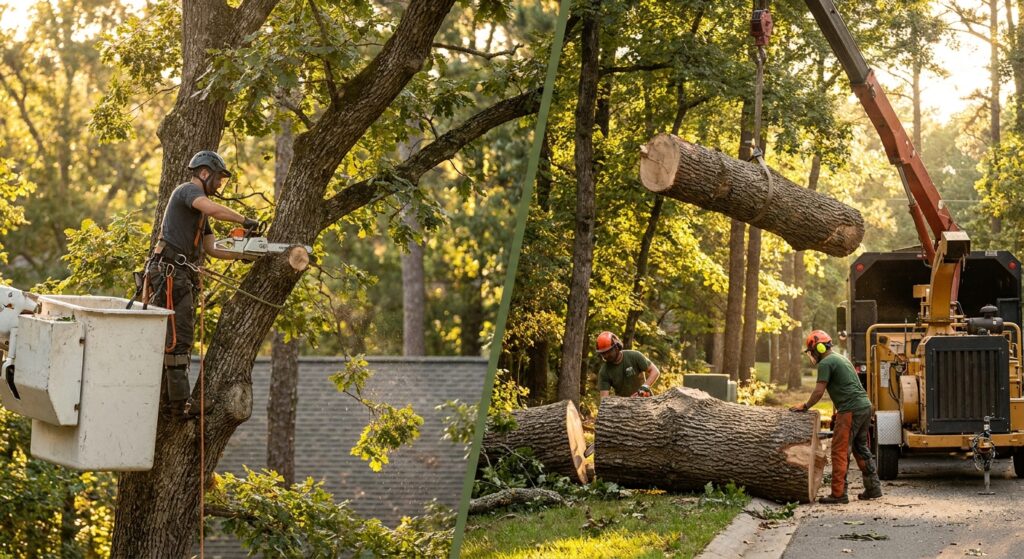
Tree trimming maintains a tree’s health and aesthetics, while tree removal is the necessary solution for dead, diseased, or structurally compromised trees that pose a direct risk to your home. The correct choice is based entirely on a professional assessment of the tree’s structural integrity, health, and proximity to property.
When to Choose Tree Trimming (Pruning)
Trimming, or corrective pruning, is a preventative maintenance service. It is designed to manage growth, remove potential hazards, and improve the overall health and longevity of a tree. This is not just about appearance; it is about proactive risk management for your property.
Consider professional trimming if you notice the following:
- Branches are growing too close to your roof, windows, or Eskom power lines.
- Dead, broken, or diseased limbs are present in the canopy.
- The tree’s canopy is overly dense, blocking sunlight to your garden or lawn.
- The tree requires shaping to improve its structure after a storm or period of unbalanced growth.
When Tree Removal is the Only Option
Tree removal is a final resort, reserved for situations where a tree has become a liability that cannot be corrected through pruning. The primary goal of removal is to eliminate a significant and unavoidable threat to people and property. Delaying removal of a compromised tree can lead to catastrophic structural failure.
Our teams will recommend removal under these conditions:
- The tree is dead or in advanced stages of decline with more than 50% of the canopy gone.
- There are major cracks in the main trunk or significant root decay is visible.
- The tree is leaning precariously towards a structure after a storm.
- Its root system is damaging foundations, paving, or underground plumbing.
The Diagnostic Process: How We Assess Your Tree
Our assessment is a diagnostic evaluation, not guesswork. A Power Tree Fellers specialist analyses the tree’s biology and structural mechanics to determine the safest course of action. We identify the root cause of any problems before recommending a service.
Assessing Structural Integrity
We examine the tree for signs of weakness that could lead to failure, especially during Highveld storms or coastal winds. This includes looking for deep fissures in the trunk, hollow sections, fungal growth on the bark, and evidence of a compromised root plate. A tree that looks healthy from a distance may have critical structural faults.
Identifying Disease and Pests
Certain diseases and infestations compromise a tree beyond recovery. We look for signs like extensive borer damage which severs the tree’s vascular system, or the presence of fungal brackets at the base, which indicates internal rot. In these cases, trimming is ineffective as the core problem cannot be resolved.
Professional Solutions and Compliance
Attempting large-scale tree work without certified training and equipment is a significant safety risk. An incorrect cut can unbalance a tree, causing it to fall in an unpredictable direction and damage property. Our certified teams operate with precision and a clear safety protocol.
The benefits of using our professional service include:
- Use of specialised rigging to safely lower large limbs without damaging your roof or garden.
- Full public liability insurance for your protection.
- Compliance with municipal bylaws regarding protected tree species.
- Complete site cleanup and responsible disposal of all green waste.
Book a Call-Out with Power Tree Fellers
As the Senior Operations Manager at Power Tree Fellers, I can assure you that our teams are fully equipped to diagnose and resolve any tree-related issue safely and efficiently. An incorrect assessment can lead to unnecessary costs or, worse, significant damage to your home from a falling tree. We ensure the job is done correctly in compliance with all South African residential safety standards. Get a quote or request a call-out using the button below.
FAQs
Can a leaning tree be saved by trimming?
If the lean is gradual and the root system is stable, corrective pruning to reduce weight on one side can sometimes help. However, a sudden lean, particularly after heavy rain or wind, often indicates root failure and typically requires immediate removal for safety.
How often should trees on my property be inspected?
We recommend a professional inspection every two to three years for mature trees, or annually if you have large trees close to your home. This allows us to identify potential issues like disease or structural weakness before they become serious hazards.
Are you insured for property damage?
Yes, Power Tree Fellers carries comprehensive public liability insurance. This protects your property against any unforeseen accidents during the tree trimming or removal process, a critical safeguard that DIY or uninsured operators cannot provide.