
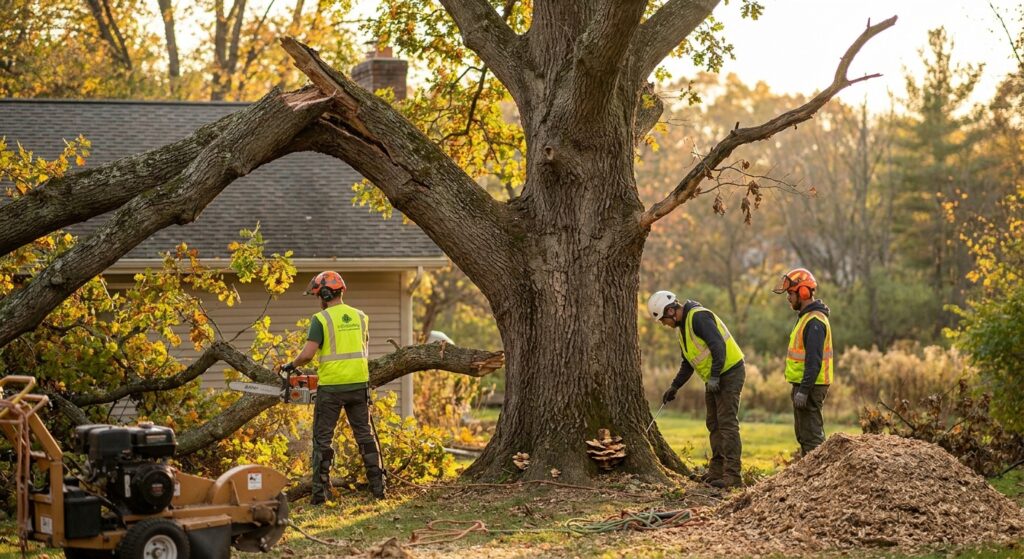
A tree requires removal when it presents a clear safety risk. The most direct warning signs are a sudden or worsening lean, large dead or dying branches, and visible decay like cavities or fungal growth on the trunk. These symptoms indicate a loss of structural integrity, meaning the tree may no longer be able to support its own weight. Ignoring these signs transitions a tree from a property asset to a significant liability.
Structural Integrity: The Core Principle of Tree Safety
A tree’s ability to remain standing is a function of physics. Its root system acts as an anchor, while its trunk and branches must support immense weight against forces like wind and gravity. When disease, decay, or damage compromises any part of this system, the risk of failure increases dramatically, especially during the high winds of a Gauteng thunderstorm.
Critical indicators of structural failure include:
- A new or accelerating lean, which signals root system failure.
- Heaving soil or cracks in the ground at the base on the side opposite the lean.
- Deep, open cracks or cavities in the trunk or main branches.
- More than 50% of the tree’s canopy appearing dead or in decline.
These are not cosmetic issues; they are mechanical faults that precede a collapse.
Understanding Fungal Decay Mechanics
The presence of fungal growth, such as shelf-like conks or mushrooms on the trunk or near the base, is a definitive sign of internal decay. Fungi work by breaking down the essential structural components of wood, primarily cellulose and lignin. This process fundamentally weakens the tree from the inside out.
White Rot vs. Brown Rot
Different fungi cause different types of decay. White rot fungi break down both lignin and cellulose, leaving the wood feeling soft, spongy, or stringy. Brown rot fungi primarily consume cellulose, which causes the wood to become dry, brittle, and crack into cubical pieces. Brown rot is often considered more serious as it causes a rapid and significant loss of bending strength.
Assessing Root System Failure
A tree’s stability is entirely dependent on its root system anchoring it to the ground. When roots are damaged, diseased, or decaying, the entire structure becomes unstable. Damage often occurs from nearby construction, soil compaction, or poor drainage, which can starve the roots and lead to rot.
Key signs of a compromised root system include:
- Sudden leaning, especially after storms or heavy rain.
- Mushroom or fungal growth appearing on the soil over the roots.
- Cracked or heaving soil around the tree’s base, indicating the root plate is shifting.
- Canopy dieback, where leaves and branches at the top of the tree die for no apparent reason.
The Threat of Boring Insects in South Africa
Pest infestations can severely weaken a tree, sometimes leading to its death. In South Africa, the Polyphagous Shot Hole Borer (PSHB) is a significant threat. This tiny beetle bores into the tree and introduces a fungus, which then attacks the tree’s vascular system, blocking the transport of water and nutrients.
Evidence of a dangerous borer infestation includes:
- Numerous small, round exit holes in the bark.
- Sawdust-like material (frass) at the base of the tree or in bark crevices.
- Branch dieback and eventual tree death.
Precision Solutions with Power Tree Fellers
Do not leave the safety of your property to chance. A visual inspection often reveals only a fraction of a tree’s true condition. Our experts provide a technical assessment to identify structural weaknesses before they lead to catastrophic failure. Contact us via our form to schedule a professional evaluation and get a clear quote for ensuring your safety.
FAQs
Can a leaning tree be saved?
It depends on the cause and severity. A tree that has grown with a gradual lean may be stable, but a tree that develops a sudden or worsening lean is dangerous and often requires removal as it indicates root failure.
Is a hollow trunk always a sign that a tree must be removed?
Not necessarily. A tree can survive with a hollow trunk if the surrounding ring of healthy wood is thick and strong enough to support it. However, a large cavity, especially near the base, significantly compromises structural integrity and requires an expert assessment.
What do mushrooms growing on my tree’s trunk mean?
Mushrooms (also called conks or brackets) are the fruiting bodies of decay fungi. Their presence is a reliable indicator that the tree is suffering from internal rot, which weakens the wood and makes the tree hazardous.
What are the signs of the Shot Hole Borer beetle?
Key signs include small, distinct holes in the bark, often with staining, resin drops, or sawdust-like powder around them. As the internal fungal infection spreads from the beetle, you will notice wilting and dying branches.