
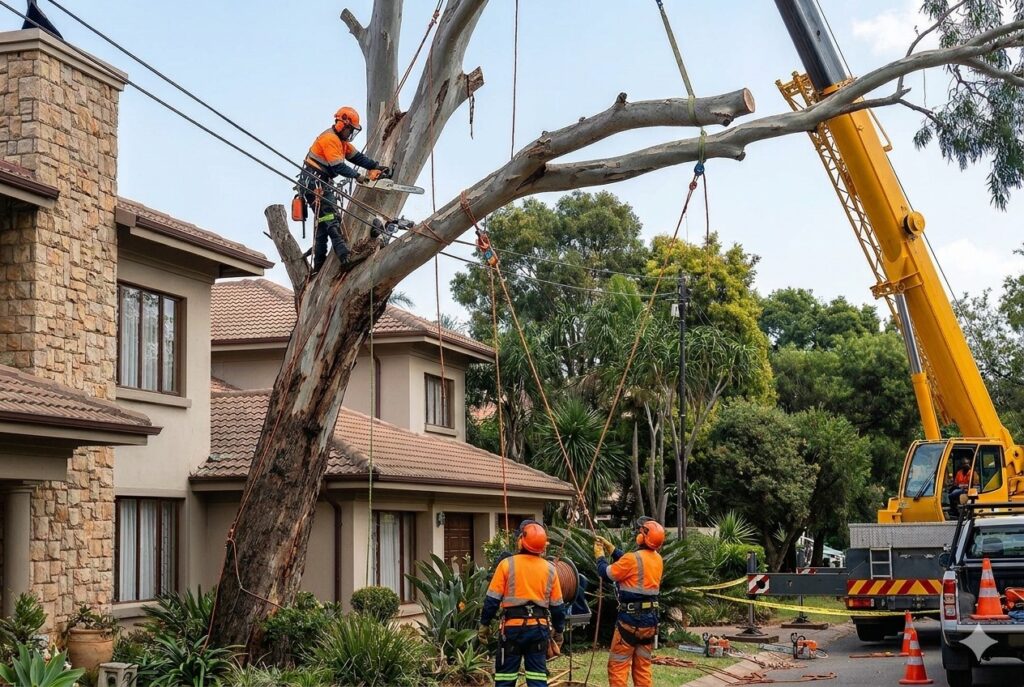
A tree threatening a structure requires methodical, technically proficient removal. The optimal strategies involve sectional dismantling with advanced rigging for control in confined spaces and crane-assisted removal for large or unstable trees with limited access. These approaches mitigate property damage and ensure operational safety.
Identifying the Signs: When is a Tree Near a Building Considered “Dangerous”?
Through analyzing structural defects and environmental hazards, our arborists provide a factual risk profile to determine when removal becomes a technical necessity:
- Critical Structural Defects: Warning signs such as a progressive lean, root heave, or large cavities indicate compromised stability and internal decay, signaling that the tree’s primary anchors can no longer support its weight.
- Infrastructure and Utility Hazards: Trees encroaching power lines or municipal services require specialized coordination and de-energization protocols, as they present extreme electrical and fire risks to the surrounding area.
- Overhanging Limb Dynamics: Heavy branches with weak, V-shaped attachments over roofs or walkways pose a constant threat of failure during high winds or heavy rain, necessitating a detailed analysis of weight distribution and attachment strength.
This systematic evaluation ensures that proactive steps are taken to mitigate hazards before they result in catastrophic property damage.
Why “Dangerous” Tree Removal is Never a DIY Project
Attempting to remove a high-risk tree near structures without certified training is a dangerous miscalculation of the complex physical forces involved. Professional removal utilizes advanced rigging and sectional dismantling to control the descent of every limb, transforming an unpredictable hazard into a precise engineering task.
Beyond the physical danger, DIY attempts expose you to massive legal and financial liability, as standard insurance often excludes damages caused by such high-risk negligence. By hiring a qualified team with public liability coverage and SAQA-aligned expertise, you ensure the safety of your property while transferring all operational risks to insured professionals.
Professional Techniques for High-Risk Tree Removal
Professional high-risk tree removal replaces guesswork with engineering, utilizing specialized methodologies to protect your home and landscape:
- Sectional Dismantling: This method involves a certified arborist ascending the tree to systematically remove sections from the crown downward.
- Advanced Rigging Systems: High-tensile ropes, pulleys, and friction brakes are employed to carefully lower heavy timber, preventing free-fall and protecting roofs, fences, and delicate landscaping from impact damage.
- Crane-Assisted Extraction: For exceptionally large or structurally unsound trees with zero ground access, mobile cranes are used to lift entire sections up and away from buildings to a safe processing zone.
- SAQA-Qualified Precision: Every operation is executed by experts trained in tree biology and mechanical physics, ensuring that the choice of equipment and technique aligns with international safety standards.
These advanced techniques transform a high-stakes hazard into a manageable, controlled operation.
Safety Protocols and Site Preparation
High-risk tree removal requires a disciplined site preparation plan that establishes a secure, restricted work zone before any cutting begins. Our team performs a comprehensive hazard assessment to identify utility lines and structures, utilizing synchronized communication systems and full Personal Protective Equipment (PPE) to ensure crew safety.
Protecting landscaping with heavy-duty mats and conducting rigorous equipment checks, this systematic approach minimizes operational risk and ensures every phase of the project is controlled and efficient.
Legal Requirements: Permits and Utility Coordination
Understanding these legal obligations ensures your project proceeds without the risk of work stoppages or significant financial penalties:
- National Forests Act Compliance: Certain indigenous species, such as Yellowwoods and Stinkwoods, are strictly protected; removing them without a license from the Department of Forestry, Fisheries and the Environment (DFFE) is a criminal offense.
- Municipal Permit Requirements: Local by-laws in major cities like Cape Town and Johannesburg often require permits for trees located on verges or those of a specific size and cultural significance.
- Body Corporate and HOA Approvals: Properties governed by sectional title schemes or homeowners’ associations must obtain formal consent from the body corporate to ensure alignment with estate-specific regulations.
Adhering to these regulatory frameworks is essential for a legally sound and responsible removal process.
Trust Power Tree Fellers with Tree Removal Near Buildings
Our solutions are engineered for guaranteed performance and precision in the complex South African urban environment. We deploy certified arborists and industry-leading equipment to ensure every high-risk removal is executed with absolute control.
This mitigates all risks to your property; a professional consultation is the first step to ensuring regulatory compliance and the safe, effective removal of any dangerous tree. Contact us now to get a quote using the button below.
FAQs
How can I tell if a tree is leaning dangerously toward my home?
A tree leaning dangerously will often show signs of root failure. Look for heaving soil or cracks in the ground on the side of the tree opposite the lean. A sudden or recent increase in the lean, especially after a storm or heavy rain, is a red flag requiring immediate expert assessment.
Is it safe to remove a large tree near a building without a crane?
Yes, it can be safe, provided the correct technique is used. For many situations, sectional dismantling with advanced rigging is the standard method. A certified arborist dismantles the tree piece by piece, lowering each section with ropes in a controlled manner. A crane is typically necessary only when the tree is too unstable to climb or there is no safe area to lower the sections.
How much does it cost to remove a tree that is touching a building?
The cost is determined by the complexity of the removal, not a flat rate. Factors include the tree size, stability, and the specific techniques required, such as sectional rigging or crane assistance. Its direct contact with the building increases the risk and demands a more intricate and precise removal process, which will be factored into the final quote.