
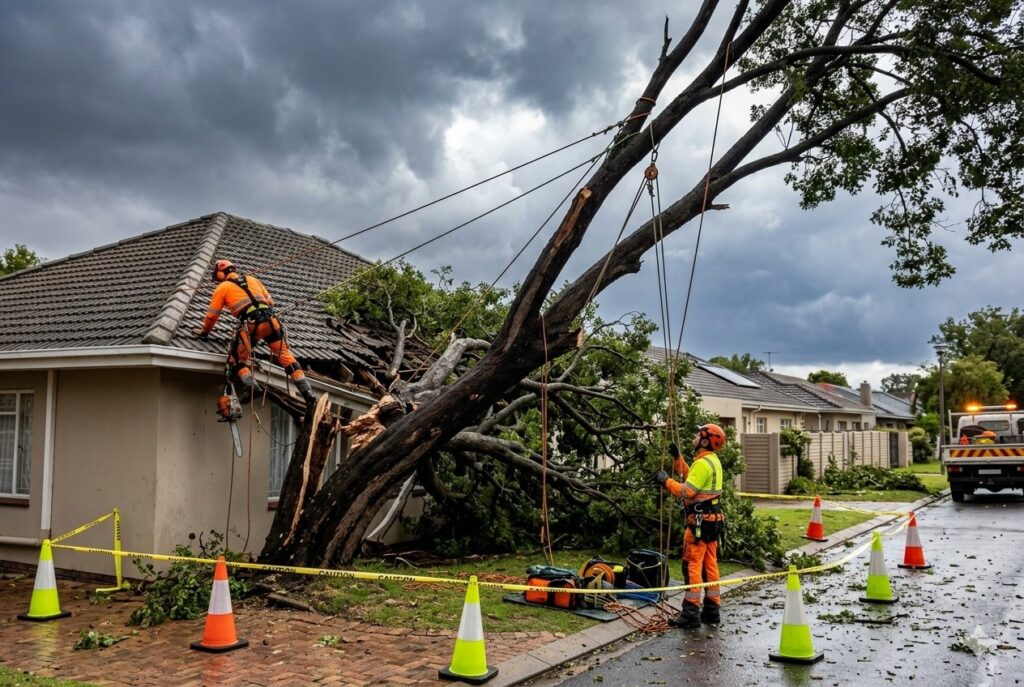
Your priority is securing the site and mitigating immediate risk. Our first actions involve a full hazard assessment, neutralising electrical threats, and then systematically dismantling the compromised tree to prevent secondary damage to structures or personnel. We operate strictly within South African safety protocols for high-risk arboricultural work.
What to Do Right After a Storm Hits
After a storm, prioritize safety by inspecting your property from a distance and avoiding any contact with downed power lines, which must be treated as lethal. Once the area is declared safe by professionals, thoroughly document all damage with photographs to support future insurance claims and contact your provider immediately to report the incident.
While clearing small debris is acceptable, you should avoid tackling large or unstable limbs yourself. Instead, secure the area and contact a certified arborist to perform a professional structural assessment.
Our Process: What to Expect During Emergency Tree Removal
This methodical response ensures that every phase of the removal is executed with technical precision and a focus on site safety:
- Initial Assessment and Risk Management: The process begins with a rapid evaluation of utility line contact and structural instability to formulate a safe work plan.
- Tactical Threat Mitigation: Our crew first addresses immediate hazards, such as securing shifting trunks or removing “widow-maker” branches suspended in the canopy.
- Precision Rigging and Dismantling: Using advanced rigging ropes and controlled cutting techniques, our arborists dismantle the tree in manageable sections.
- Processing and Site Restoration: Once the tree is safely on the ground, it is processed into chips and logs for efficient removal from your property. Our service concludes with a thorough cleanup of the work area, ensuring all operational debris is cleared, and the site is left in a safe, orderly condition.
Adhering to this rigorous operational workflow, we transition your property from a hazardous state to a secure one. This professional standard guarantees that the emergency is handled with the highest level of care for your safety and investment.
Assessing the Damage: When is Tree Removal a True Emergency?
A tree removal emergency is defined by an immediate risk to people or property, such as a tree falling on a structure, blocking access, or tangling with power lines. Critical but less obvious threats include a sudden lean, which indicates root failure, or “widow-makers,” which are broken branches trapped in the canopy that can fall without warning.
You should inspect the trunk for deep vertical cracks or splits and check the base for heaving soil or fungal growth, as these signs suggest severe structural instability. While not all storm damage requires total removal, high-risk indicators like these necessitate a professional assessment.
Navigating Insurance Claims for Storm-Damaged Trees
Managing an insurance claim for storm damage in South Africa requires a methodical approach to documentation and a clear understanding of your policy coverage:
- Evidence and Notification: Immediately capture date-stamped photographs of the damage from multiple angles before starting any cleanup. Notify your insurer as soon as possible to receive a claim number and an assigned assessor.
- Quote Acquisition: Standard insurance procedures typically require at least two written quotes from professional tree service providers. These quotes should clearly detail the scope of the removal.
- Administrative Record-Keeping: Maintain a comprehensive file of all correspondence with your insurance company, including the names of representatives and the times of each interaction.
By following these steps, you ensure that your claim is backed by the necessary technical and procedural evidence for a successful payout.
Why You Should Hire a Certified Professional for Emergency Felling
Hiring an unqualified operator for emergency tree work introduces unacceptable safety risks and significant financial liability. Certified arborists possess the specialized training to manage the complex tensions of storm-damaged trees, using advanced rigging and cutting techniques to prevent further property damage.
Unlike uninsured operators who transfer risk to the homeowner, professional services carry comprehensive public liability insurance and adhere to strict industry best practices. By conducting site-specific risk assessments and utilizing precise rope access methods, professionals ensure a controlled and safe removal process.
Power Tree Fellers: Your Trusted Tree Felling Company
Our solutions are engineered for guaranteed performance and precision within the demanding South African environment. We do not offer temporary fixes; we provide systematic, compliant arboricultural services designed to secure your property and preserve valuable assets.
A professional consultation with our specialists ensures that any action taken is not only effective but also aligns with municipal bylaws and industry safety standards. Get a quote using the button below.
FAQs
Does homeowners’ insurance cover the cost of emergency tree removal?
Typically, your insurance will cover the removal cost only if the tree has fallen on and damaged an insured structure, like your house or boundary wall. If it falls in an empty part of the garden, the removal cost is usually for your account.
What should I do if a tree has fallen on my house or car?
First, ensure everyone is safe and keep a clear distance from the area. Do not attempt to climb the structure or remove any part of the tree. Contact your insurance provider immediately to report the damage and then call a professional emergency tree felling service.
How do I know if a leaning tree is likely to fall after a storm?
A sudden lean after a storm is a critical warning sign of root failure. Look for cracked or mounded soil at the base on the side opposite the lean. If the tree is leaning more than 15 degrees from vertical or is directed towards a house or high-traffic area, it should be assessed by a professional immediately.