
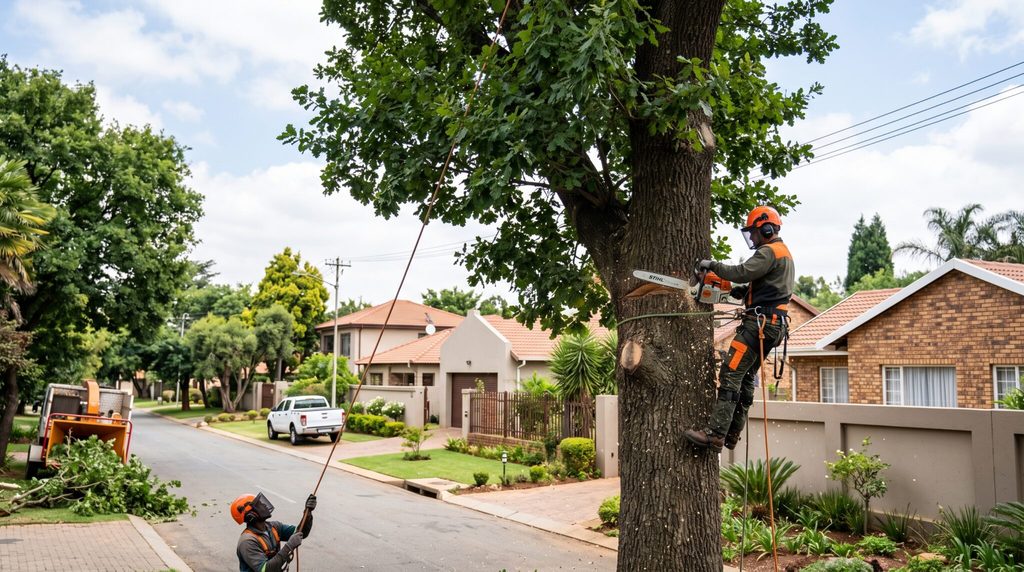
No, you generally do not need a municipal permit to fell a standard garden tree on your private property in Centurion. While ordinary garden trees are usually exempt, understanding whether you need permission to cut down a tree in Centurion depends heavily on the tree’s species, size, and exact location. Most residential properties in suburbs like Lyttelton, Eldoraigne, or Wierda Park allow homeowners to manage their own vegetation freely, but specific legal guidelines still apply to protected species, municipal infrastructure, and shared boundaries.
When Is a Permit Legally Required in Centurion?
While local bylaws do not interfere with standard backyard gardening, certain situations require formal intervention. You cannot simply chop down any tree without checking its legal status, especially if it impacts the community or the natural environment. The City of Tshwane enforces strict guidelines to maintain the local canopy and protect public infrastructure.
Several specific scenarios require formal authorization before you can bring in a chainsaw:
- The tree is a protected national species safeguarded by forestry legislation.
- The tree is situated on municipal pavement, a roadside reserve, or a public park.
- The property is part of a secure estate or complex governed by strict body corporate rules.
- The tree is subject to a specific heritage protection order or title deed restriction.
Protected Trees Under South African Law
Even if a tree is growing entirely on your private property, national environmental laws supersede municipal permissions. Under the National Forests Act, certain native trees cannot be cut, pruned, damaged, or relocated without a special permit issued by the federal department of environmental affairs.
Some of the most common protected tree species found in and around Gauteng include:
- Camel Thorn (Vachellia erioloba), known for its hard wood and deep roots.
- Real Yellowwood (Podocarpus latifolius), the national tree of South Africa.
- Shepherd’s Tree (Boscia albitrunca), often found in drier regions.
- Marula (Sclerocarya birrea), highly valued for its cultural and ecological importance.
If you have cleared the legal hurdles and confirmed your tree is not protected, timing your project during the best time of year for tree felling in Centurion will make the process much smoother and cleaner, particularly before the heavy summer rains arrive.
Managing Trees on Boundary Lines and Complex Properties
Boundary lines are a frequent source of neighborly tension in residential areas. If a tree trunk sits directly on the boundary line, it is joint property. Neither neighbor can chop it down or severely damage its health without mutual agreement. In sectional title schemes and residential estates, common property trees belong to the body corporate, meaning individual owners cannot authorise felling on their own.
If you are dealing with a tree on a shared boundary or within a residential estate, follow these steps to avoid disputes:
- Obtain written consent from your neighbor if the trunk sits on your shared boundary line.
- Consult your estate HOA trustees or body corporate before trimming any common area greenery.
- Log an official service request with the City of Tshwane if a pavement tree is lifting your wall or blocking public cables.
- Confirm who is financially responsible for the tree work before scheduling any contractors.
Before booking a crew for your private yard, it is wise to review typical tree felling costs in Centurion so you can budget accurately for the work and avoid surprises.
Precision Solutions With Power Tree Fellers
Handling tree removals in Centurion requires a solid understanding of local bylaws, safety protocols, and proper equipment. Our team handles everything from identifying protected species to safely rigging large branches near power lines or tight boundary walls. Reach out for a quote or assistance with your next property maintenance project by clicking the button below.
FAQs
Do I need a permit to cut down a tree in my own yard?
Generally, no. You do not need municipal approval for standard, non-protected garden trees on your own property. However, you must get a permit if the tree is a protected species under the National Forests Act, such as a Yellowwood or Camel Thorn.
What happens if I cut down a protected tree without a permit?
Removing or damaging a protected tree without permission from the Department of Forestry, Fisheries, and the Environment is a serious offence in South Africa. It can result in heavy fines, criminal charges, or even jail time.
Can I cut down a tree on the pavement outside my house?
No, you cannot cut or prune pavement trees yourself. Trees on the roadside belong to the City of Tshwane. If a municipal tree is causing issues, you must log a query directly with the municipality so their teams can handle it safely.
Do I need permission to trim branches hanging over my boundary?
Under South African common law, you are allowed to cut back branches that overhang your boundary line, provided you only cut up to the property line. However, you must return the cut branches to your neighbor, as they legally own the wood.